

 11 June, 2026
What is Geographic Tongue? A Guide for Parents on a Common and Benign Condition
Many parents experience deep anxiety when they notice white streaks on their child’s tongue that form highly diverse shapes—sometimes closely resembling a map, and other times looking like white, arching wave crests.
What is Geographic Tongue (Benign Migratory Glossitis)?
Geographic tongue is characterized by map-like patches of depapillation (loss of tongue papillae) found on the dorsum (top surface) of the tongue. The lesions are commonly located in the center or along the lateral borders of the tongue, and can coexist in both areas. Occasionally, they spread to the underside of the tongue, though with much lower frequency. In pediatric dentistry, geographic tongue consistently ranks among the top 5 most common oral mucosal disorders in children.
Current clinical evidence suggests that the exact etiology (cause) is multifactorial and remains a subject of ongoing debate. However, numerous studies indicate a strong genetic and immunomediated component, backed by a higher incidence among members of the same family. Furthermore, geographic tongue has a documented association with psoriasis. Additionally, psychological stress, hormonal fluctuations, and micronutrient deficiencies (such as vitamin B6, B12, folate, and zinc) have been reported to trigger flare-ups or exacerbate symptoms.
Diagnosing Geographic Tongue
The distinct clinical features of geographic tongue make it relatively easy to diagnose. A typical lesion presents with:
-
Smooth, Erythematous Patches: Red, glossy areas on the tongue surface caused by the temporary loss of papillae.
-
Elevated Borders: The red patches are framed by a slightly raised, white or light-yellow wavy border.
-
Serpentine, Map-Like Patterns: The irregular, winding shapes mimic the lines of a geographical map.
-
Migratory Nature: The lesions “walk” or move. An affected area may heal and completely disappear within a few days or weeks, while entirely new patches emerge on a different part of the tongue.
While the vast majority of patients experience absolutely no pain, approximately 10% to 20% report a tingling or burning sensation, particularly when consuming spicy, salty, or acidic foods, as well as alcoholic beverages. Some cases present concurrently with a fissured tongue (deep grooves on the tongue surface) or localized hypersensitivity. Notably, the severity of discomfort does not correlate with the size or extent of the lesions.
A Benign and Harmless Condition
Geographic tongue is primarily diagnosed through clinical evaluation based on the morphology of the lesions and their classic migratory behavior. Routine laboratory tests are unnecessary unless the lesions present atypically, exhibit a complex progression, or raise suspicion for alternative oral conditions such as oral lichen planus, oral candidiasis (thrush), or nutritional deficiency glossitis. In such rare instances, diagnostic workups may include evaluations of vitamin B12, folate, iron, and ferritin levels, or a fungal culture/stain. A tissue biopsy is almost never warranted.
In pediatric patients, localized discomfort often manifests immediately after the child or parent notices the lesions, suggesting that psychological awareness plays a significant role in symptom perception. Geographic tongue remains one of the oral mucosal conditions that causes the most distress for parents, despite being entirely benign and harmless.
The irregular red patches on the dorsum of a child’s tongue, bordered by winding white lines that constantly shift shapes and “migrate” over time, easily create the illusion of an aggressive, unmanageable disease. It is this unpredictable cycle of vanishing and reappearing that alarms families, sometimes causing them to suspect severe systemic illnesses.
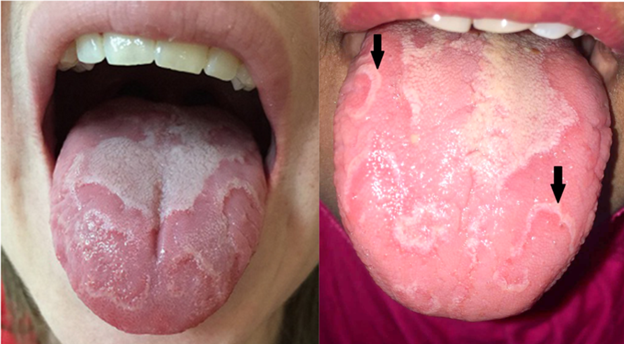 Distinct clinical features allow for a highly straightforward diagnosis of geographic tongue.
How is Geographic Tongue Managed?
Clinical management for this condition is strictly symptomatic and supportive. Standard protocols include:
-
Rinsing with mild, antimicrobial or antiseptic mouthwashes.
-
Reinforcing thorough, gentle oral hygiene guidelines.
-
Avoiding hot, spicy, highly acidic foods, and alcohol to minimize mucosal irritation.
-
Supplementing micronutrients if an underlying vitamin or mineral deficiency is verified.
-
Avoiding any aggressive or unnecessary clinical interventions.
In rare cases where extensive, severe ulceration or deep inflammation develops, topically applied immunomodulators may be prescribed under strict medical supervision. The long-term prognosis is excellent; the condition is completely harmless and yields no systemic complications, though it may recur in cyclical episodes. Crucially, there is absolutely no scientific evidence linking geographic tongue to malignant transformation (cancer) or permanent tongue deformation.
As a child grows into adulthood, episodes of geographic tongue typically diminish in frequency and often resolve entirely. Consequently, parents are strongly encouraged to minimize anxiety and focus on partnering with a pediatric dentist to maintain routine oral health monitoring. Seeking professional dental cleanings and checkups twice a year is recommended to secure accurate diagnoses and optimal care.
6 Essential Takeaways for Parents on Geographic Tongue:
-
Entirely Benign and Harmless: It is not a dangerous disease or a sign of malignancy.
-
Cyclical Yet Self-Limiting: The condition frequently flares up in episodes but often resolves permanently as the child matures.
-
Typically Asymptomatic: The majority of children feel no pain; only a small percentage experience mild burning or sensitivity.
-
Triggered by Internal Stressors: Stress, physical fatigue, illness, or nutrient deficiencies can make the lesions more pronounced.
-
No Special Treatment Required: If your child is comfortable and pain-free, no active medical intervention is necessary.
-
Avoid Self-Medication: Refrain from applying random over-the-counter ointments or forcing unnecessary treatments on the tongue.
When Should You Consult a Dental Specialist?
Parents should take their child to see an oral health professional if:
-
The lesions lose their migratory trait and remain stagnant in one location for an abnormally prolonged period.
-
The child experiences significant pain, causing a fear of eating or fluid intake.
-
There is suspicion of alternative, concurrent oral pathologies or infections.
— Social Life & Health Magazine: 6 Things to Note About Geographic Tongue in Children
Nhu Ngoc Dental Clinic